Europasinfonie
When Distance Becomes Irrelevant
In June 2027, Dresden will witness a moment that rewrites musical history. For the first time ever, orchestral musicians from twelve European countries will perform together in real time—despite being separated by distances of up to 2,200 kilometers. With Europasinfonie, the Dresdner Sinfoniker present a project that is both technologically groundbreaking and artistically visionary, demonstrating how digital innovation can revolutionize classical music.
Live Music Without Borders
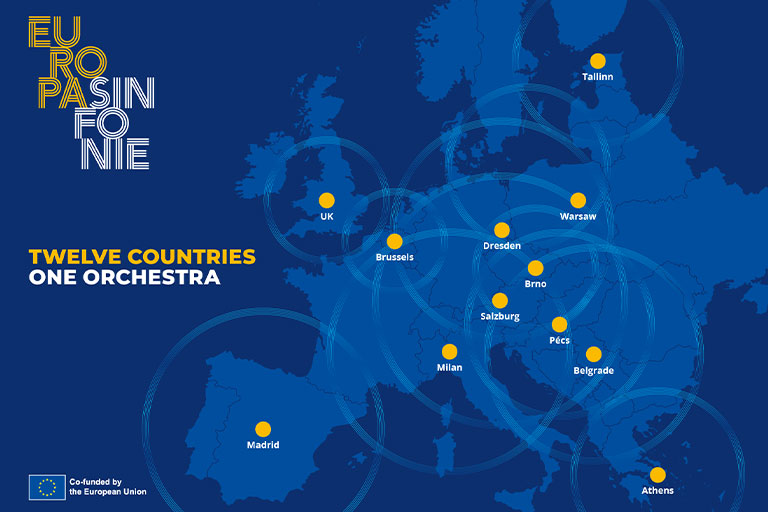
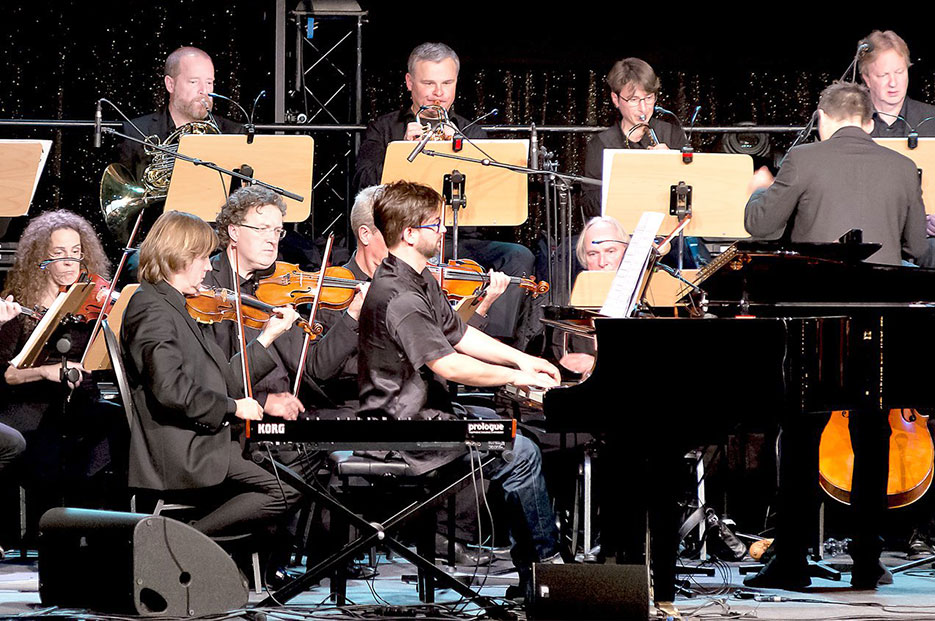
The concept is as simple as it is audacious: 62 string players of the Dresdner Sinfoniker perform on stage in Dresden under the baton of conductor Andrea Molino. Simultaneously, wind players, percussionists, and two choirs from eleven other European musical capitals—from Athens to Madrid, from Brussels to Milan—play live from their home cities. Through ultra-fast fiber optic connections, their video and, crucially, their sound are transmitted to Dresden in real time. There, the musicians are projected life-size and integrated seamlessly into the visual landscape. The audience experiences a complete symphony orchestra with choir—united both optically and acoustically.
A Technological Breakthrough Makes the Impossible Possible
Years of development by the Dresdner Sinfoniker in collaboration with Prof. Alexander Carôt of Anhalt University have made this innovation a reality. The challenge was formidable: signal delay (latency) had to be reduced to an absolute minimum—only then can musicians play synchronously across vast distances. That goal has been achieved.
What once seemed impossible is now audible proof that technology can serve art without compromising it.
A European Network for Knowledge Transfer and Collaboration
Europasinfonie is far more than a one-time concert. The project envisions establishing a digital platform with permanent “remote studios” throughout Europe. Musicians, orchestras, and composers will be able to rehearse, record, and produce across borders—without the burden of travel, with minimal environmental impact, and open to experimental projects that would struggle to find space in conventional concert programming.
This infrastructure doesn’t just connect cities. It connects creative minds.
Composition Competition
As part of the project, European composers are invited to write specifically for this innovative format, exploring the creative possibilities of a digitally distributed orchestra. The three winning compositions will be selected by a distinguished international jury and announced in early October 2026.
A European Statement
Europasinfonie is more than artistic ambition. It is a demonstration of European cooperation in practice—a call for ongoing dialogue among all Europeans, not only in the artistic sphere but in the spirit of partnership that defines the best of what Europe can be. At a time when division threatens, Europasinfonie creates connection. Where borders exist, it creates harmony.
Europasinfonie is co-funded by the European Union through the Creative Europe Programme. Views and opinions expressed are however those of the author(s) only and do not necessarily reflect those of the European Union or the European Education and Culture Executive Agency (EACEA). Neither the European Union nor EACEA can be held responsible for them.
The Dresdner Sinfoniker are supported by the Saxon State Ministry for Science, Culture and Tourism and by the City of Dresden through the Office for Culture and Monument Preservation. They are co-financed by tax funds based on the budget approved by the Saxon State Parliament.
Concert Date
18 June 2027 | Dresden
Messe Dresden
Hall 1
Artistic Partners
- Dresdner Sinfoniker (Germany) – String orchestra
- Athens State Orchestra (Greece) – Clarinettes
- tbc (UK) – Piano/Celesta & Harp
- Brussels Philharmonic (Belgium) – Percussion
- Czech Philharmonic Choir Brno (Czech Republic) – Choir
- Estonian National Symphony Orchestra (Estonia) – Tuba & Trombones
- Mozarteum Salzburg (Austria) – Choir
- No Borders Orchestra (Serbia) – Trumpets
- Orchestra Sinfonica di Milano (Italy) – Flutes
- Orquesta Sinfónica de Madrid (Spain) – Bassons
- Pannon Philharmonic (Hungary) – Horns
- Sinfonia Varsovia (Poland) – Oboes
Musical Director
- Andrea Molino
Technical Partners
- Hochschule Anhalt, Köthen
- Prof. Alexander Carôt
- PxB Studios GmbH, Berlin
- Fraunhofer-Institut für Nachrichtentechnik (HHI), Berlin




Medienecho